Credentialed and Compensated: The Unbroken Market for Authoritative Opinion
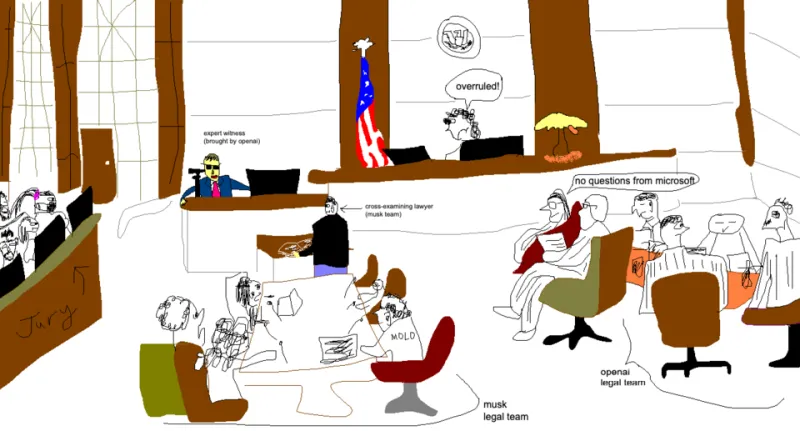
Photo: Oeoi, CC0, via Wikimedia Commons
In a federal courtroom in Chicago in 2019, two economists testified about the same merger. One concluded that the transaction would harm consumers through reduced competition. The other concluded that it would benefit consumers through enhanced efficiency. Both held doctorates from research universities. Both had published in peer-reviewed journals. Both were being paid by the party whose position their testimony supported.
The judge, presumably, was expected to determine which economist was correct.
This is not a modern problem wearing modern clothes. It is a modern problem wearing the same clothes it wore in Athens in the fourth century BCE, which is to say it is not really a problem at all — it is a feature, built into the architecture of adversarial legal proceedings since adversarial legal proceedings were invented, because the people who invented them were human beings with the same cognitive architecture you and I are running.
The Athenian Marketplace of Credentialed Opinion
Athenian law courts were, by contemporary standards, chaotic. There were no professional judges in the modern sense. Large citizen juries — sometimes numbering in the hundreds — decided cases by majority vote after hearing arguments from both sides. The parties generally spoke for themselves, but a robust industry of speechwriters, known as logographers, prepared their arguments for them.
The logographer's job was not to find the truth. It was to construct the most persuasive possible version of his client's position. Demosthenes, before he became a celebrated orator, earned his living writing speeches for litigants who would deliver them as their own. The practice was understood, accepted, and entirely legal. What mattered was not who composed the argument but whether the jury found it convincing.
 Photo: Demosthenes, via c8.alamy.com
But the Athenians also developed something closer to what we would recognize as expert testimony. Cases involving medical questions called upon physicians. Cases involving property boundaries called upon surveyors. Cases involving the quality of goods called upon merchants experienced in the relevant trade. These witnesses were not disinterested parties stumbled upon by chance. They were sought out, approached, and — the historical record is unambiguous on this point — compensated for their time and their conclusions.
Aristophanes mocked the practice in his comedies. Plato complained about it in his dialogues. The complaints did not change the practice, because the practice was not a deviation from the system. It was the system's logical consequence.
 Photo: Aristophanes, via c8.alamy.com
Rome Institutionalizes the Market
Roman law was considerably more formalized than Athenian procedure, and its approach to expert opinion reflects that formalization. Roman courts developed the concept of the peritus — a person with recognized expertise in a technical domain — whose testimony carried evidentiary weight that ordinary witness accounts did not.
The peritus was theoretically obligated to offer an honest assessment. Roman legal writing is full of admonitions about the duty of truthful testimony and the penalties for perjury. But Roman legal writing is also full of evidence that the peritus system functioned, in practice, as a market. Wealthy litigants retained more and better experts. The experts retained by wealthy litigants had professional incentives to maintain relationships with wealthy litigants. The testimony of retained experts showed a remarkable tendency to support the positions of the people who had retained them.
This was not primarily a story about individual dishonesty. Roman jurists who examined the problem closely understood that something more structural was happening. When a man whose livelihood depends on the continued approval of a class of clients is asked to render a judgment that might damage those clients, the honest answer and the professionally advantageous answer point in different directions. Most people, most of the time, find ways to make those directions converge.
The Romans called this a problem of character. We would call it a conflict of interest. The underlying psychology is identical, and it has not been solved in the intervening two thousand years.
The American Expert Witness and the Daubert Standard
The United States federal courts spent much of the twentieth century wrestling with precisely this dynamic. The traditional approach — allowing any witness with claimed expertise to testify and leaving credibility assessments to juries — produced predictable results. Plaintiffs found experts who supported plaintiffs. Defendants found experts who supported defendants. Juries, lacking the technical knowledge to evaluate competing claims, often defaulted to proxies like the witness's institutional affiliation or presentation style.
The Supreme Court's 1993 Daubert v. Merrell Dow Pharmaceuticals decision attempted a structural fix. Federal judges were tasked with serving as gatekeepers, screening proposed expert testimony for scientific reliability before it reached juries. The intention was to elevate the quality of expert evidence by filtering out opinion that lacked genuine methodological foundation.
The results have been debated extensively. What is not seriously disputed is that the expert witness industry did not shrink after Daubert. It grew. The added layer of judicial scrutiny created demand for experts who could credibly survive that scrutiny — which meant experts with stronger credentials, more prestigious institutional affiliations, and more sophisticated methodological packaging. The market did not disappear. It upgraded its product.
Today, expert witness consulting is a multi-billion-dollar industry. Major litigation consulting firms maintain rosters of academics and professionals available for retention. Some witnesses earn more from testimony than from their primary professional activities. The most sought-after experts command fees that would have impressed a Roman peritus.
The Independence Illusion
The standard defense of the expert witness system is that cross-examination exposes bias, that opposing experts cancel each other out, and that a sophisticated fact-finder can navigate competing testimony to reach accurate conclusions. This defense is not entirely without merit. Cross-examination does sometimes reveal the gaps between a witness's published research and their courtroom claims. Opposing experts do sometimes usefully clarify the actual boundaries of professional consensus.
But the defense rests on an assumption about human cognition that the evidence does not support: the assumption that people can reliably identify and discount the influence of financial incentives on their own reasoning.
Decades of psychological research — conducted, yes, on college students, but replicated in professional settings with real stakes — consistently show that people are substantially worse at this than they believe themselves to be. Professionals who are asked to evaluate ambiguous evidence while working for a party with a preferred outcome tend to find that outcome supported by the evidence. They are not lying. They are not, in most cases, consciously shading their conclusions. They are doing what human beings reliably do when motivated reasoning and professional identity point in the same direction: they find the answer that causes the least internal disruption.
The Athenians knew this. The Romans knew this. Every legal reformer who has attempted to design bias out of expert testimony has rediscovered it. The knowledge has not produced a solution, because there is no structural solution that does not also eliminate the adversarial system itself — and the adversarial system exists because it produces other outcomes that legal cultures have consistently valued more than epistemic purity.
What the Fee Reveals
There is a version of this story that ends with a call for reform: stricter disclosure requirements, court-appointed neutral experts, mandatory publication of prior testimony records. These reforms have been proposed, in various forms, since Roman jurists first articulated the conflict-of-interest problem. Some have been implemented. None have resolved the underlying dynamic.
The more honest conclusion is that the expert witness market is not a malfunction. It is a faithful expression of what happens when human beings — with human motivations, human cognitive limitations, and human professional ambitions — are placed inside an institutional structure that pays for authoritative opinion.
The two economists in the Chicago courtroom were not corrupt. They were responding rationally to the incentives in front of them, as humans have responded to similar incentives for four thousand years. The ancient Athenian logographer understood the assignment. The Roman peritus understood the assignment. The modern litigation consultant understands the assignment.
The assignment has always been the same: take what you genuinely know, apply it to what your client genuinely needs, and find the place where those two things overlap. In most cases, that place is large enough to stand in. The credential is real. The methodology is defensible. The conclusion, arrived at by a mind that is not entirely free of the knowledge of who is paying the invoice, lands where it was always going to land.
This is not a scandal. It is a description of human beings operating under conditions that human beings have always operated under. The old routes run straight through the expert witness box, and they were never going anywhere else.