Every Road Has Always Had a Landlord: The Ancient Logic of Taxing Movement
There is a toll plaza on Interstate 95 in Delaware that collects money from drivers who have, in most cases, already paid for the highway through federal and state fuel taxes. The drivers know this. The state knows this. Everyone involved understands that the toll is, in some meaningful sense, a second charge for the same service. And yet the plaza has stood since 1963, collecting without interruption, because the logic behind it is not really about roads at all. It is about the oldest revenue insight in the history of organized government: people who are moving cannot easily refuse to pay.
This insight did not originate in Delaware. It originated, as best historians can determine, somewhere along the first caravan routes of the ancient Near East, roughly four thousand years ago. And it has not required a single conceptual update since.
The Roman Calculation
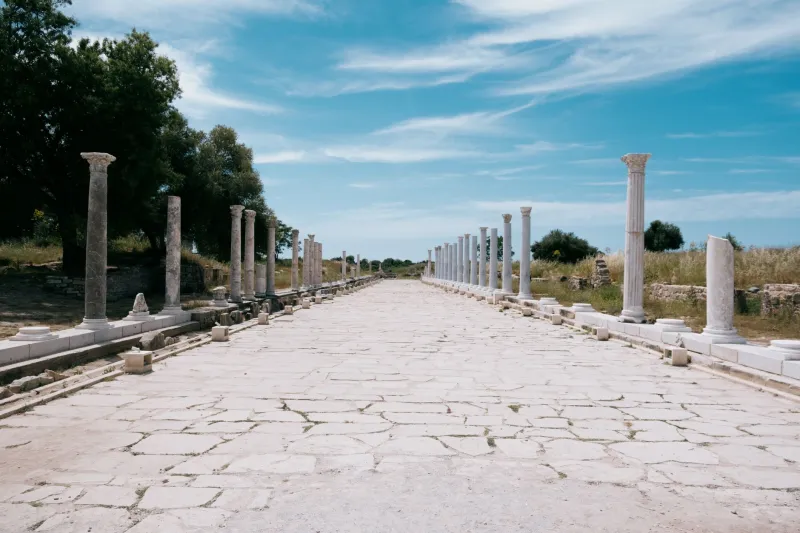
Rome is famous for its roads, and rightly so. At the empire's peak, roughly fifty thousand miles of paved highway connected its provinces, an engineering achievement that would not be matched in scale for more than a millennium. What receives less attention is the financial architecture that surrounded those roads.
Roman road tolls, known as portoria, were levied not just at city gates but at river crossings, mountain passes, and provincial boundaries — anywhere the geography created a chokepoint that travelers could not reasonably avoid. The rates were formalized under Augustus and varied by cargo type, distance, and the political status of the traveler. Merchants paid more than citizens. Foreigners paid more than merchants. The system was, in modern terms, a tiered pricing model with dynamic rate adjustment based on the customer's ability to negotiate.
Critically, the Romans did not build roads and then decide to toll them. The revenue expectation was built into the infrastructure decision from the beginning. A road through a mountain pass was valuable precisely because it was the only road through a mountain pass. The engineering created the monopoly, and the monopoly justified the engineering. The two were inseparable.
Medieval Bridges and the Geometry of Captivity
If Rome perfected the road toll, medieval Europe perfected the bridge toll — and in doing so, revealed just how little the underlying psychology had shifted in a thousand years.
A bridge in the medieval period was not merely a convenience. It was frequently the only means of crossing a river for twenty miles in either direction. The lord who controlled the bridge controlled, effectively, the commercial life of the surrounding region. Bridge tolls in thirteenth-century England were levied on livestock, grain, wool, timber, and travelers on foot. The rates were published — posted at the bridge entrance in a formal document called a toll board — which gave the arrangement a veneer of transparency while obscuring the fundamental coerciveness of the situation. You could read exactly what you were being charged. You could not, in any practical sense, refuse.
The Plantagenet kings understood this geometry well enough to make bridge-building a deliberate instrument of royal revenue policy. Authorizing a new bridge meant authorizing a new income stream, and the crown was careful to retain a share. The infrastructure was nominally public. The returns were reliably private. This distinction — public cost, private benefit — is one that modern highway finance scholars would recognize immediately.
The American Turnpike and the Myth of the Free Road
The United States spent much of the nineteenth century building toll roads, then spent much of the twentieth century convincing itself that it had moved beyond them. The Interstate Highway System, launched under Eisenhower in 1956, was framed as a national defense project — a public good funded by public money, available to all without direct charge at the point of use. It was, in the political imagination of the era, the anti-toll road.
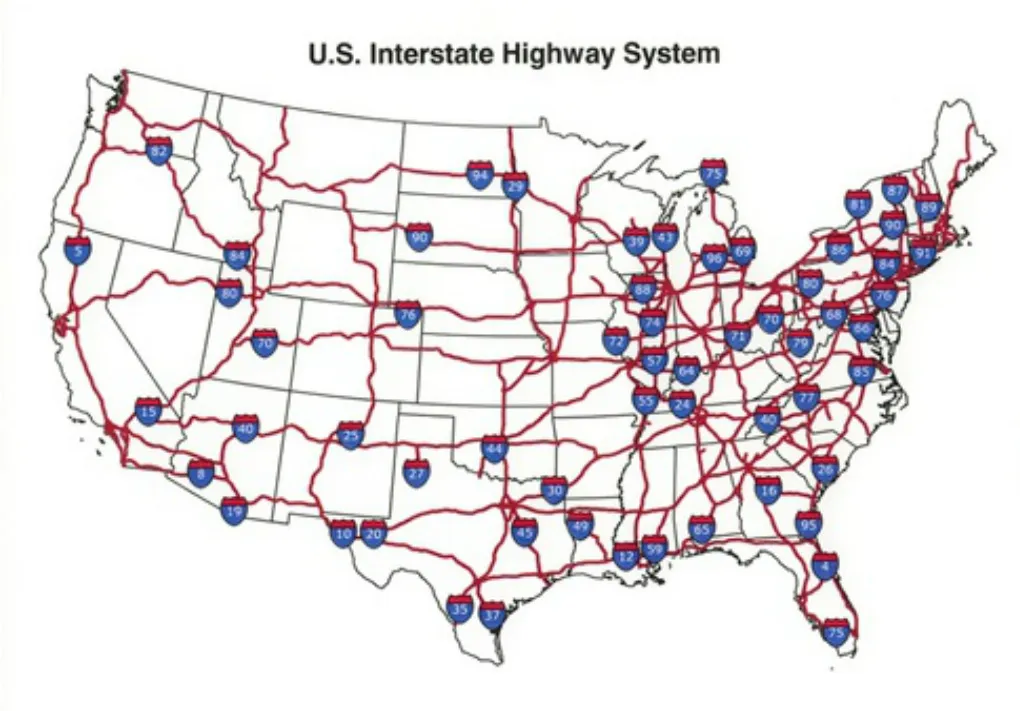 Photo: Interstate Highway System, via highwayactof1956.weebly.com
This framing was always partially fictional. The system was funded by the Highway Trust Fund, which drew its revenue from federal fuel taxes — a consumption charge levied on every gallon purchased, whether or not the buyer ever touched an interstate. Drivers who never left their county helped pay for corridors they would never use. The road was free at the gate and expensive everywhere else.
More telling is what happened next. As the Interstate System aged and maintenance costs mounted, states began reintroducing direct tolling on federally funded highways — often on the same roads whose original construction had been financed by the tax-funded trust. By the 2020s, tolling had expanded to cover roughly five thousand miles of the interstate network, with more under legislative consideration. The fuel tax remained. The tolls were added on top of it. Delaware's situation, it turned out, was not an anomaly. It was the destination.
The Technology Changes; the Extraction Doesn't
Electronic tolling has made the modern version of this system nearly frictionless. E-ZPass and its regional equivalents allow charges to be assessed at highway speed, without booths, without cash, without the slight theatrical awkwardness of handing money to a stranger in a small booth. The transaction has been made invisible, which is to say it has been made easier to accept.
This, too, has ancient precedent. Roman tax farmers — the publicani — operated tollgates as private concessions, collecting fees on behalf of the state in exchange for a percentage of receipts. The arrangement was efficient and, for the collectors, extremely profitable. It was also widely resented, which is why tax collectors appear in the New Testament as shorthand for moral compromise. The publicani understood, as modern toll operators understand, that the less visible the extraction, the less resistance it generates. The E-ZPass transponder is a direct descendant of the publican's ledger: a mechanism for making an unavoidable charge feel like a background condition rather than a decision.
What the Pattern Reveals
The consistency of this history is not a coincidence, and it is not a conspiracy. It is the product of a stable human situation: governments need revenue, infrastructure is expensive, and people who are in motion are, almost by definition, engaged in an activity valuable enough to justify the cost of movement. That last fact makes them willing — if not exactly happy — to pay for access to the paths that enable it.
Every civilization that built roads, bridges, or canals eventually arrived at the same conclusion: the infrastructure was worth more as a toll mechanism than as a public good. The political language around this conclusion has varied enormously across four thousand years. The math has not.
The next time you slow for a toll plaza — or, more likely, simply drive through one while your transponder registers a charge you will see on a statement three weeks later — you are participating in one of the oldest fiscal relationships in human history. The road was never really free. Someone always owned it. And the owner always found a way to make you pay.