When Progress Demanded Dynamite: The American Communities That Chose Destruction Over Decay
The Mathematics of Sacrifice
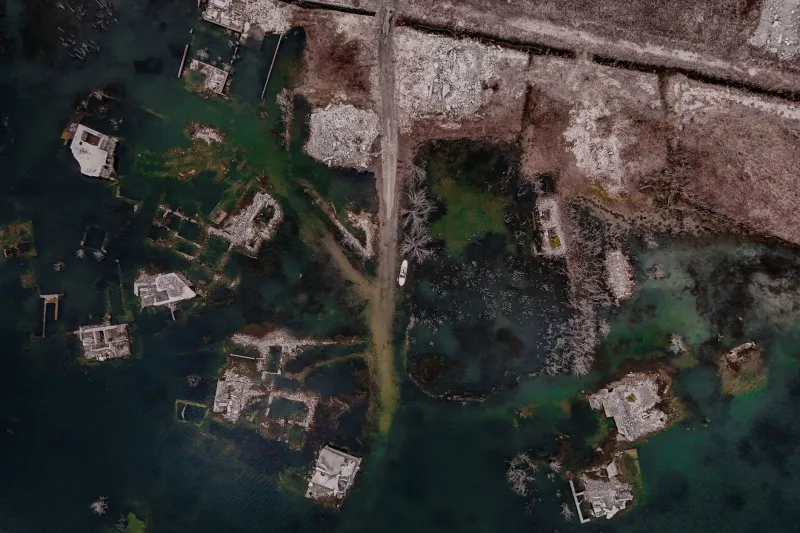
In 1936, the residents of Butler, Tennessee, watched the Tennessee Valley Authority flood their entire town beneath Watauga Lake. They had voted for it. The federal government offered compensation, relocation assistance, and the promise that their sacrifice would bring electricity and prosperity to the broader region. Within months, Main Street disappeared under forty feet of water, along with the courthouse, the school, and the cemetery where three generations lay buried.
 Photo: Watauga Lake, via c8.alamy.com
Butler was neither the first nor the last American community to choose deliberate self-annihilation. The pattern stretches back to colonial settlements that voted to burn their own buildings rather than surrender them to advancing armies, and forward to modern neighborhoods that supported urban renewal projects designed to erase them entirely. What connects these episodes across three centuries is not desperation, but a peculiar form of collective optimism—the belief that destruction is the necessary prelude to something better.
The Ancient Logic of Starting Over
This impulse toward constructive destruction has deep historical roots. Ancient cities routinely demolished entire districts to make way for new construction, often with the enthusiastic support of residents who believed that newer meant better. Roman emperors gained popularity by tearing down old neighborhoods and replacing them with grand public works, even when the displaced residents had nowhere else to go.
The psychology driving these decisions remains remarkably consistent. Communities facing economic stagnation or social problems often become convinced that their physical environment is the source of their troubles. Rather than address underlying issues of governance, education, or economic opportunity, they embrace the fantasy that bulldozers and dynamite can solve what politics and patience cannot.
The Promise of Federal Money
American communities proved especially susceptible to this logic when federal programs offered to fund their reinvention. The urban renewal programs of the 1950s and 1960s convinced hundreds of cities to demolish functioning neighborhoods on the promise that modern housing projects and commercial developments would follow. Cities competed to qualify for federal dollars that required them to prove their existing communities were "blighted" enough to warrant total reconstruction.
The results followed a predictable pattern. Boston's West End, a dense Italian-American neighborhood, was bulldozed to make way for luxury apartments that displaced the original residents. Detroit's Black Bottom district, a thriving center of African-American business and culture, was demolished for a highway that fragmented the remaining community. In both cases, local officials and many residents initially supported the projects, convinced that destruction would lead to renewal.
The Appalachian Experiment
Nowhere was this psychology more evident than in Appalachia, where the Tennessee Valley Authority convinced entire communities to accept submersion beneath artificial lakes. The residents of these doomed towns weren't forced from their homes at gunpoint—they were sold a vision of regional transformation that required their individual sacrifice.
The TVA's promises weren't entirely empty. The dams did bring electricity, flood control, and recreational opportunities to the broader region. But the communities that voted to drown themselves rarely benefited from these improvements. Their sacrifice powered distant cities and created lakes for tourists who had never heard their names.
The Highway to Nowhere
Urban renewal reached its most destructive phase when it merged with the Interstate Highway System. Cities discovered they could use federal highway funds to demolish neighborhoods they had already decided to eliminate. The highways became tools of social engineering, their routes carefully planned to bisect minority communities and working-class districts that lacked political power to resist.
 Photo: Interstate Highway System, via canaria.guide
New Orleans destroyed the Tremé neighborhood for an interstate spur that was never completed. Syracuse obliterated its 15th Ward, a thriving African-American community, for I-81. In case after case, cities used the promise of economic development to justify destroying existing communities, then abandoned the projects when federal priorities shifted or local opposition finally organized.
The Modern Inheritance
This pattern hasn't disappeared—it has simply adapted to contemporary circumstances. Modern communities still vote to demolish themselves, though the justifications have evolved. Stadium projects convince neighborhoods to accept condemnation for sports complexes that promise economic development. Gentrification programs persuade residents that their displacement is temporary, necessary for improvements they'll eventually enjoy.
The psychology remains unchanged: the belief that progress requires destruction, that communities must be torn down before they can be built up, and that individual sacrifice serves collective good. What's different is the scale and sophistication of the promises made to secure consent.
The Persistence of Optimism
The most striking aspect of these episodes is not the destruction itself, but the enthusiasm with which communities embraced their own elimination. Residents who voted to flood their towns or demolish their neighborhoods genuinely believed they were making rational choices for better futures. They weren't victims of deception—they were participants in a form of collective magical thinking that has proven remarkably durable across centuries.
This optimism reflects something fundamental about how humans process change and loss. When faced with decline or stagnation, communities often find it easier to imagine dramatic transformation than gradual improvement. The promise of starting over appeals to the same psychological impulses that drive individuals to abandon careers, end relationships, or move across the country in search of better lives.
The Geography of Wishful Thinking
The communities most susceptible to these promises shared certain characteristics: economic distress, social isolation, and limited political power. They were places where residents felt trapped by circumstances beyond their control, making them receptive to any proposal that promised escape. The specifics of the promises mattered less than their scope—the bigger the transformation, the more believable it seemed.
This pattern continues today in communities that vote for casinos, sports stadiums, and development projects that require demolishing existing neighborhoods. The promises are remarkably similar to those made to Butler, Tennessee, in 1936: short-term sacrifice for long-term prosperity, individual loss for collective gain, and the transformation of familiar places into something unrecognizably better.
The old routes through these lost communities are now underwater, buried beneath concrete, or marked only by historical plaques that few people stop to read. But the psychology that destroyed them remains as powerful as ever, waiting for the next generation of planners with grand visions and federal funding to offer communities the chance to vote themselves out of existence.